Thailand Floods 2026: Bangkok and Pattaya Rainfall, Road Closures and Flight Delays
Bangkok recorded 487 mm of rain between September 1 and 25, 2026. That was about 1.8 times the 1991 to 2020 average for the same period. In Pattaya, 171.4 mm fell on September 23 alone.
The water did more than flood roads. It prevented some airport workers from reaching Suvarnabhumi Airport, reduced ground-handling capacity and contributed to an approximately eight-hour delay for Thai Airways flight TG644 from Bangkok to Nagoya.
Read the Japanese version of this article
The footage below, published by FNN Prime Online in Japanese, shows extensive flooding in Bangkok.
| Indicator | Recorded figure |
|---|---|
| Bangkok rainfall, September 1 to 25 | 487 mm |
| 1991 to 2020 average for the same period | About 269 mm |
| Rainfall compared with average | About 181% |
| Parts of Bangkok over roughly 48 hours from September 24 | About 300 mm |
| Pattaya rainfall on September 23 | 171.4 mm |
| Delay to Thai Airways flight TG644 on September 27 | About 8 hours |
Bangkok received 487 mm in 25 days
The clearest measure of the event was Bangkok’s accumulated rainfall.
According to reporting based on data from Bangkok’s Department of Drainage and Sewerage, the city received 487 mm from September 1 to 25. The 1991 to 2020 average for the same period was about 269 mm, putting 2026 at roughly 181% of normal.
The city had already experienced a wet month when prolonged heavy rain arrived on September 24. The Public Relations Department of the Thai government reported that close to 300 mm fell in some areas over about 48 hours. Water entered major canals faster than the drainage system could remove it.
September is normally near the peak of Bangkok’s rainy season, so heavy rain by itself is not unusual. The scale and concentration of the September 2026 rainfall were the more important factors.
Full canals and overwhelmed drainage
Bangkok’s main canals reached full capacity as intense rain continued.
The city’s pumping stations were reportedly moving about 1,200 cubic metres of water per second. Even so, at least 13 major roads flooded. Conditions were particularly serious in eastern districts and along canals, where water reached waist height in some communities.
Reports said about 980 people entered temporary shelters and 36 bedridden residents were transferred to hospitals. On September 26, all 50 districts of Bangkok were designated as flood-disaster areas. That did not mean every street had the same water depth, but it showed that emergency operations were required across the city.
Pattaya received 171.4 mm in one day
Pattaya, about 150 km southeast of Bangkok, was hit by intense rainfall during the same period.
The Thai Meteorological Department’s weekly weather summary recorded 171.4 mm in Pattaya, Bang Lamung district, Chon Buri province, on September 23. The department described widespread heavy to very heavy rain across central and eastern Thailand during the latter part of September 18 to 24, with flooding reported in several areas.
Water rose quickly in low-lying parts of Pattaya after heavy rain began around midday. Local reporting said floodwater approached one metre in some locations, making roads impassable for small vehicles. Streets in one of Thailand’s best-known beach destinations temporarily looked more like rivers.
Why the rain became so intense
No single weather system explains the flooding.
The Thai Meteorological Department reported that a monsoon trough extended across central and eastern Thailand. A strong low-pressure system over the central South China Sea moved toward Cambodia and affected Thailand along the trough. The southwest monsoon over the Andaman Sea, Thailand and the Gulf of Thailand also strengthened during part of the period.
The result was a combination of moist southwesterly air, a trough where rain clouds could repeatedly develop, and a nearby low-pressure system. Large amounts of water then reached urban drainage networks within a short time.
The airports stayed open, but access roads did not
For travellers, the problem was not simply whether an airport runway remained usable. Reaching the airport became part of the disruption.
The Tourism Authority of Thailand’s visitor information said that both Suvarnabhumi and Don Mueang airports continued operating. However, serious flooding affected the Lat Krabang route to Suvarnabhumi. Travellers were advised to use Motorway No. 7 or the Burapha Withi Expressway instead.
International passengers were encouraged to arrive at least three hours before departure, while domestic passengers were advised to allow at least two hours. Airport Rail Link, BTS and MRT services offered alternatives to road travel where available.
That advice was current at 6 p.m. on September 27, 2026. Flood and transport conditions can change quickly, so travellers should always check current information from their airline, airport, the Thai Meteorological Department and local transport operators.
Why flight TG644 was delayed for about eight hours
Thai Airways flight TG644 illustrated how an urban flood can affect aviation even when an airport remains open.
The flight was scheduled to leave Suvarnabhumi Airport for Nagoya at 12:05 a.m. on September 27. It was also due to carry Thai athletes travelling for the 2026 Asian Games. According to local reporting, the aircraft eventually departed at around 8 a.m., roughly eight hours behind schedule.
The runway was not the main problem. According to an airport explanation reported by the Thai government Public Relations Department, some Thai Airways ground-handling staff could not reach work because of flooding across Bangkok. Some baggage carts also malfunctioned, slowing both loading and unloading.
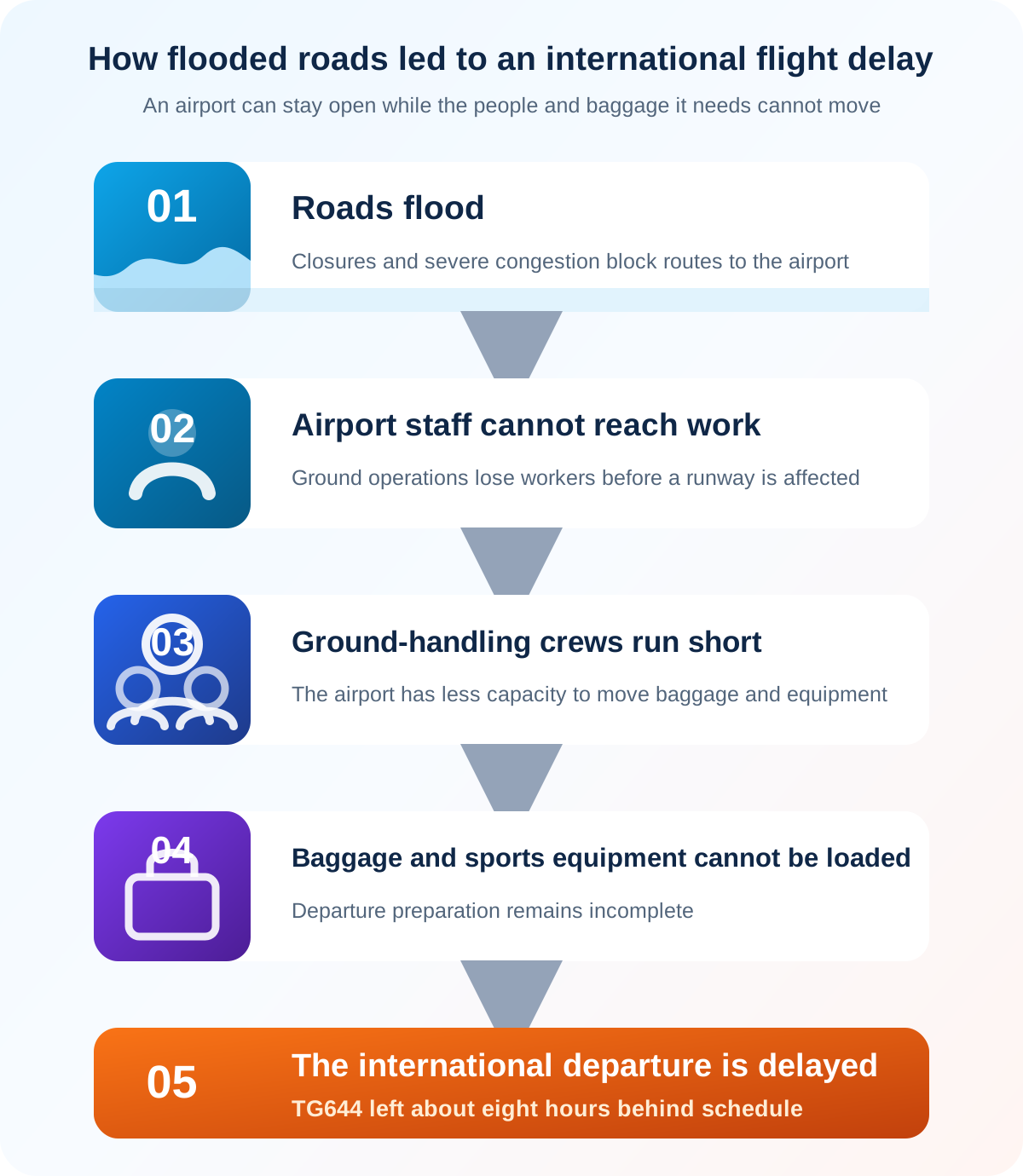
The sequence matters. Flooded roads prevented workers from reaching the airport. Fewer ground-handling staff were available. Baggage and sports equipment could not be loaded on time. The aircraft therefore could not complete its departure preparations.
Protecting a runway from flooding is only one part of aviation resilience. Roads, rail links, staff travel and ground-support equipment all belong to the same transport system.
Can this flood be attributed to climate change?
It would be premature to say that human-caused climate change directly caused this individual flood.
As of September 28, 2026, no event-attribution study specifically quantifying the role of climate change in this Bangkok and Pattaya rainfall event had been identified. The monsoon trough, low-pressure system, southwest monsoon, urban terrain and drainage conditions all need to be considered.
That does not contradict longer-term evidence of changing extreme weather in Thailand. A 2026 study using observations from 1970 to 2022 reported a widespread increase in compound events where extreme heat was followed within three days by heavy rainfall. The study provides background on long-term risk, but it does not determine the cause of this specific flood.
What this event clearly demonstrated was the way concentrated rainfall can affect drainage, roads, workers and airport operations in sequence.
What the September 2026 floods showed
Bangkok received 487 mm of rain between September 1 and 25, about 1.8 times the long-term average for the same period. Some parts of the city received close to 300 mm over roughly 48 hours. Pattaya recorded 171.4 mm in one day.
On September 27, flight TG644 departed about eight hours late. The delay was linked not to a closed airport, but to workers who could not travel through the flooded city and to problems with ground-support equipment.
An open airport does not guarantee an on-time flight. In a major urban flood, the roads, railway links, staff and equipment outside the runway perimeter can determine whether the aviation network continues to move.
Sources
- Thai Meteorological Department: Weekly Weather Summary, September 18 to 24, 2026
- Thailand PRD: Bangkok Residents Urged to Stay Home as Heavy Rain Floods Major Roads
- Tourism Authority of Thailand: Weather and travel conditions in Bangkok and surrounding areas
- Channel NewsAsia / AFP: Bangkok declares disaster after homes flooded, roads submerged by heavy rain
- Asia-Pacific Journal of Science and Technology: Increasing compound hot-rainfall extreme in Thailand during 1970-2022